Ports are no longer passive backdrops; their infrastructure and policy frameworks actively determine the design choices for shipboard climate systems. For operators and shipyards, the ripple effects reach into equipment sizing, energy sources and maintenance regimes — whether choosing a compact small air conditioner for boat or integrating full-scale chillers. This is policy-impact thinking applied to thermal comfort, and it demands both engineering rigour and commercial sense.
Why port policy matters for marine HVAC
Ports set emissions zones, berth power availability and shore-power schedules; those factors shape whether vessels run auxiliary generators or plug into grid-supplied electricity. Since the IMO 2020 global sulphur limit that came into force on 1 January 2020, harbour authorities have increased scrutiny on on-dock emissions and energy efficiency. The consequence: HVAC choices now weigh electrical load profiles, inverter-driven compressor efficiency and refrigerant selection against berth constraints.
Practical impacts on system selection and design
Two immediate engineering consequences appear. First, a shift to electrically powered systems when shore power is available reduces onboard fuel use but raises peak demand at berth — one must design for higher starting currents and consider soft-starts or inverter drives for compressors. Second, when vessels remain at sea for extended intervals, components such as evaporator coil sizing and condensate drainage (including a condensate pump) require different maintenance cadences to avoid microbiological issues and corrosion.
Case study anchor: Port of Singapore and berth electrification
The Port of Singapore’s progressive berth electrification program provides a real-world anchor: ports offering shore power change operator economics overnight. Ships that can accept shore power run their HVAC on cleaner grid energy and reduce generator hours; those that cannot must prioritise fuel-efficient equipment, like variable-speed compressors and higher-BTU-per-watt designs. My editorial work with coastal refit yards in India observed how retrofits to accept shore power reduced onboard generator runtime by measurable margins during port stays.
Operational trade-offs and common mistakes
Many teams underestimate lifecycle considerations. Selecting a compact, lower-capacity unit to save upfront cost often raises long-term fuel and service expenditure — especially when refrigerant types require specialised handling. Conversely, over-sizing to meet peak heat loads leads to short-cycling and degraded humidity control. Balance is central: match BTU capacity to envelope heat gain, verify compressor performance curves at expected ambient conditions, and confirm condensate management for tropical deployments.
Comparing on-board solutions: dc boat air conditioner options
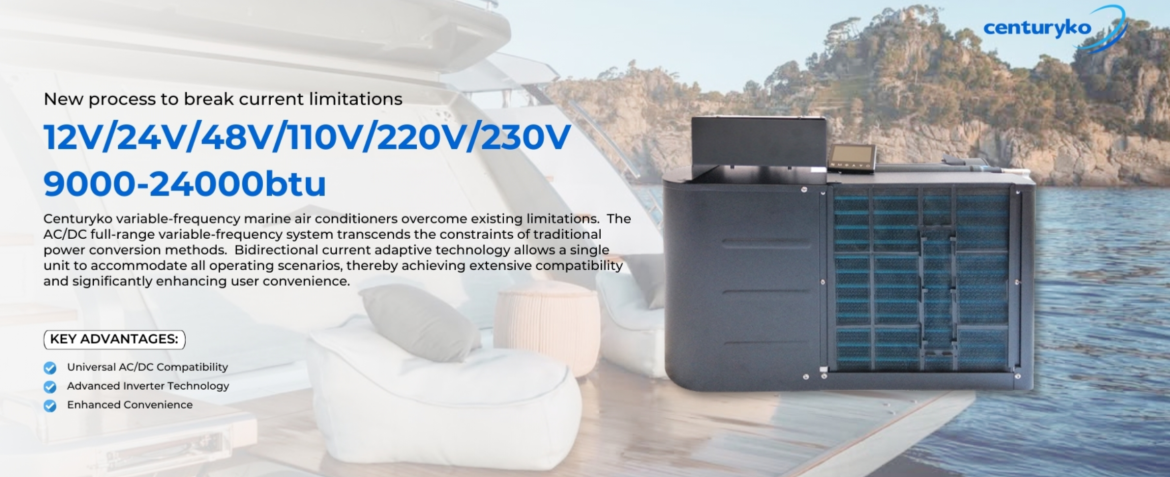
For small crafts and tenders, a dc boat air conditioner can eliminate generator dependency and simplify integration with battery banks. These systems typically use brushless DC compressors, an inverter module, and compact evaporator coils. The trade-offs are energy density versus continuous runtime: batteries limit endurance, while the lighter weight and reduced vibration help cabins and electronics alike.
Maintenance and compliance—what ports will inspect
Inspections increasingly focus on operational records and emissions during berth time. Keep logs of shore-power usage, generator hours while alongside, and scheduled servicing of key components like filters and heat exchangers. Ports prioritise visible operational metrics: reduced generator runtime, clear maintenance histories for refrigerant handling, and documented training for technicians. Small oversights—improper brazing on refrigerant lines or neglected condensate traps—can prompt corrective action.
Three golden rules for selecting marine HVAC under modern port mandates
1) Match electrical interfaces: ensure the HVAC electrical profile (starting current, running amps, inverter tolerance) aligns with available shore power and onboard distribution. Metric: peak-starting-current vs berth-supply capacity.
2) Prioritise modular efficiency: choose units with variable-speed compressors and measured COP at expected operating points. Metric: realised COP and seasonal energy use, not only rated BTU output.
3) Plan for serviceability and refrigerant stewardship: verify technician training, spare-part pathways, and clear refrigerant charge protocols to reduce port delays. Metric: mean time to repair (MTTR) and documented refrigerant recovery procedures.
These measures narrow risk and make compliant, efficient installations the practical default — a direction in which ZhuoliMarine provides product selections and integration knowledge that fit modern port realities. —